
Uncategorized
Madagascar Spices: A Complete Guide to an Exceptional Terroir
Madagascar, the Island of Spices
Sitting in the Indian Ocean like a miniature continent, Madagascar boasts exceptional biodiversity that makes it one of the richest spice-growing lands in the world. The island is the world’s first or second largest producer of several major spices, including vanilla, cloves, and Voatsiperifery pepper.
This is no accident: Madagascar’s volcanic soil, watered by regular tropical rains and warmed by generous sunshine, creates ideal conditions for the development of essential oils and aromatic compounds. At My Spices Land, we source our Madagascar spices directly from local producers.
Cloves: A Treasure from the Island of Fragrances
Madagascar is one of the world’s largest producers of cloves. This spice, actually the dried flower bud of the clove tree (Syzygium aromaticum), contains up to 20% eugenol, a powerful aromatic compound with well-known antiseptic properties.
Malagasy cloves stand out for their high essential oil content and intense notes of warm wood, resin, and camphor. They are essential in French cooking (bouquet garni, pot-au-feu, mulled wine) as well as in many cuisines around the world.
Our whole Madagascar cloves are available in 250g, 500g, and 1kg bags for professionals.
Madagascar Cinnamon
Not to be confused with Ceylon cinnamon (Cinnamomum verum), the cinnamon grown in Madagascar belongs mainly to the species Cinnamomum zeylanicum, cultivated in the island’s humid coastal regions.
Malagasy ground cinnamon offers warm, slightly spicy, and highly aromatic notes. Its reddish-brown color is characteristic of a high cinnamaldehyde content, its main active compound. It is ideal for desserts (apple tart, rice pudding, gingerbread), hot drinks, and red meat marinades.
Discover our Madagascar ground cinnamon.
Madagascar Turmeric
Turmeric (Curcuma longa) is grown in the Malagasy highlands, at altitudes that favor an exceptional concentration of curcumin, its main active ingredient. Malagasy turmeric has an intense orange-yellow color and an earthy, slightly peppery and bitter aromatic profile.
Used for thousands of years in Ayurvedic medicine, turmeric is now at the center of extensive scientific research into its anti-inflammatory properties. We offer it in two formats:
- Dried sliced turmeric: for infusions, homemade curries, and broths
- Fine turmeric powder: for smoothies, sauces, and instant preparations
Moringa: Madagascar’s Miracle Plant
Moringa (Moringa oleifera) is nicknamed « the tree of life » in Africa. Its leaves contain an extraordinary concentration of nutrients: vitamins A, B, C, and E, calcium, potassium, protein, and antioxidants. Gram for gram, moringa leaves contain 7 times more vitamin C than oranges and 4 times more calcium than milk.
Our Madagascar moringa powder is dried at low temperature to preserve all its nutrients. Its slightly herbal, earthy taste blends easily into smoothies, bowls, and sauces.
Nutmeg and Mace
Madagascar produces a significant share of the world’s nutmeg. Malagasy nutmeg is recognizable by its powerful, warm, slightly sweet aroma. Our whole nutmeg is offered whole so you can grate it fresh at the moment of use — the freshness of freshly grated nutmeg is incomparable to store-bought powder.
We also offer our ground nutmeg for added convenience.
Pink Peppercorns: The Fake Pepper Chefs Love
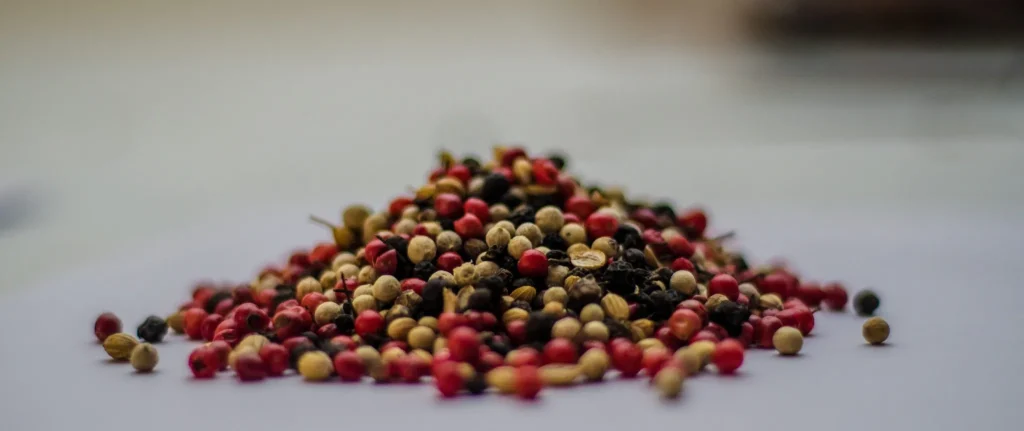
Despite what its name suggests, the pink peppercorn is not a true pepper. It is the dried fruit of the Brazilian pepper tree (Schinus terebinthifolius), a South American tree naturalized in Réunion and Madagascar. Its bright red berries offer fresh, resinous, lightly peppery notes, without the heat of true pepper.
Chefs use it widely for garnish (its berries stay whole when cooked) and to add a fresh note to cream-based sauces, fish marinades, and chocolate desserts. Our Madagascar pink peppercorns are hand-sorted for a perfect presentation.
Madagascar Peppers
Beyond wild Voatsiperifery, Madagascar also produces:
- White pepper: black peppercorns with the pulp removed by soaking. A milder, less complex flavor, ideal for white sauces.
- Ground black pepper: the everyday essential, of far higher quality than supermarket pepper thanks to its freshly ground state.
FAQ — Madagascar Spices
Are Madagascar spices organic?
Many small Malagasy producers grow their spices using traditional methods without chemical inputs, effectively close to organic farming. At My Spices Land, we select our suppliers based on sustainable farming practices and responsible cultivation.
How much Malagasy spice should you use in cooking?
The general rule: less than you think, and adjust to taste. Quality fresh spices are more concentrated than mass-market ones. For a dish serving 4: 1/2 teaspoon of cinnamon or turmeric, 2-3 whole cloves, a pinch of grated nutmeg.
Can Madagascar spices be combined?
Absolutely. Malagasy spices pair remarkably well together. Try a blend of cinnamon + cloves + nutmeg for an exceptional mulled wine, or turmeric + black pepper (pepper improves curcumin’s bioavailability) for a golden milk.